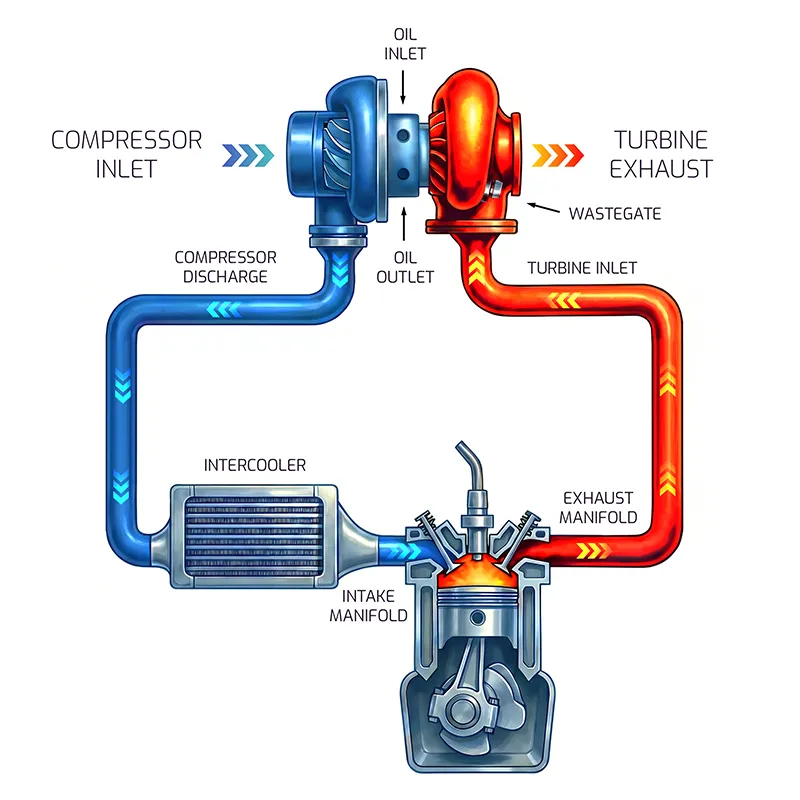
A turbocharger is made up of two main sections, commonly referred to as the hot side and the cold side. These two parts work together as a single unit, connected by a central shaft, but each has a very different role.
The hot side is connected directly to the engine’s exhaust system. It is typically made from cast iron or other heat-resistant materials, as it has to cope with extremely high temperatures and constant exposure to exhaust gases. As exhaust gases leave the engine, they are directed through the turbine housing, where they spin a turbine wheel at very high speed.
This turbine wheel is connected by a shaft to the compressor wheel on the opposite side of the turbocharger. As the turbine spins, it transfers that energy through the shaft, driving the compressor on the cold side.
The cold side is responsible for handling the incoming air. As the compressor wheel spins, it draws in fresh air from outside the engine, compresses it, and forces it under pressure towards the intake system. This increase in air pressure, or boost, allows more oxygen to enter the engine, which is what ultimately leads to increased power and efficiency.